Vacuum cleaner or vaccum: A practical, evidence-based comparison
A rigorous comparison of vacuum cleaner vs vaccum spelling, search intent, and buying guidance for homeowners and pet owners seeking reliable vacuum recommendations.


vacuum cleaner or vaccum is not just a spelling choice; it shapes search results, content accuracy, and buying guidance. The correct term, vacuum cleaner, consistently performs better for discovery, product pages, and user trust. Vaccum tends to fragment queries and reduce relevance unless content teams implement redirects and explicit mention to guide readers. Vacuum Cleaner Guide’s analysis shows spelling accuracy improves click-through and satisfaction for home cleaning topics, especially for pet owners.
The core question: vacuum cleaner or vaccum
In consumer content, spelling is a feature of trust. The term vacuum cleaner denotes the standard device used to remove dust, pet hair, and debris from floors, upholstery, and carpets. Vaccum, by contrast, is a common misspelling that surfaces in user queries and draft content. For homeowners and pet owners, the distinction matters because it influences how easily someone finds reliable guidance on product selection, maintenance, and efficiency. According to Vacuum Cleaner Guide, consistency in terminology reduces confusion and accelerates the path from query to purchase. This article explores the practical implications of spelling choices, backed by a structured, evidence-based approach. It also provides actionable steps to manage misspellings without sacrificing content quality or SEO performance.
The stakes are not only semantic: search engines interpret misspellings in ways that affect rankings and user experience. By situating vacuum cleaner as the canonical term and vaccum as a misspelling to be addressed, content teams can optimize discovery while preserving a human-friendly reader journey. The goal is to help readers—especially those dealing with pets, carpets, and hard floors—find clear, actionable guidance quickly and accurately. This section lays the groundwork for a thorough comparison that is both practical and data-informed.
Defining the terms and their practical meanings
"Vacuum cleaner" is the formal descriptor used across manuals, product pages, and reputable buying guides. It signals a device designed to create suction, capture dirt, and maintain indoor air quality. The term encompasses canister, upright, stick, and robotic variants that target different use cases—from pet hair on upholstery to fine dust on hardwood floors. In contrast, "vaccum" is widely recognized as a misspelling. While readers may type it in haste or due to keyboard layout, it does not correspond to a defined product category in most authoritative sources. For content creators and reviewers, this distinction matters for accuracy, user trust, and search performance. The Vaccum spelling issue should be treated as a navigational cue rather than a legitimate product term—unless it appears in a quoted source or as the subject of a specific spelling-focused guide. This helps prevent confusion among readers and maintains a professional standard across buying guides.
From a consumer perspective, the term vacuum cleaner aligns with a broad set of intents: comparing models, evaluating features like filtration and suction power, and planning maintenance schedules. A misspelled variant can derail those intents if not properly handled with redirects, canonicalization, or explicit mentions that correct the spelling while acknowledging the user’s query. The key is to harmonize accuracy with accessibility so readers move smoothly from search to informed decision-making.
How search intent and spelling influence discovery
Search intent around vacuum-related queries usually centers on finding a specific product type, learning about features for pet hair and carpets, or seeking buying guidance. The canonical term vacuum cleaner tends to attract higher-quality traffic because it matches official product nomenclature and category pages. When readers search vaccum, they may intend to find a product, but more often they encounter broader results, including unrelated results about vacuuming techniques, vacuum bags, or unrelated appliances. This discrepancy can dilute relevance and confuse shoppers who are comparing uprights, canisters, or robot vacuums. From an optimization standpoint, aligning content with the correct spelling—while still serving misspelling variants—is essential. Techniques like 301 redirects, canonical tags, and structured data help ensure that users reach the right pages regardless of minor spelling differences. Vacuum Cleaner Guide’s analysis shows that pages using the correct term in titles, headers, and metadata maintain stronger rankings and clearer user signals, which translate to lower bounce rates and higher time on site for a given topic. In practice, you should design content routes that honor common misspellings while reinforcing the proper term throughout the user journey.
Buying guidance: how to compare vacuums when spelling is correct vs incorrect
For buyers, the core decision framework remains consistent regardless of spelling: identify your use case, map to best-performing categories, compare key features, and evaluate after-sales support. If you search with vacuum cleaner, you’ll encounter a wide range of options: upright vacuums for quick weekly cleanups, canister vacuums for hard-to-reach areas, stick vacuums for light everyday use, and robot vacuums for automated maintenance. Key features to compare include suction power, filtration (HEPA or sealed systems for allergy needs), bin capacity or bag size, weight and maneuverability, corded versus cordless operation, and maintenance costs like bags and filters. For pet owners, look for pet hair performance, brush design, and tangle-free mechanisms; for households with hardwood floors, prioritize gentle brushes and adjustable suction. As a practical example, many readers gravitate toward mid-range models that balance price and performance in the $200-$600 bracket, though premium models can exceed that range for higher durability and specialized needs. The objective is to translate spelling choices into content that helps readers identify the right product family without losing sight of overall value and long-term ownership costs.
In the end, the choice of spellings should not limit your ability to deliver precise and actionable guidance. The strongest approach is to anchor content in correct terminology while providing navigational safety nets for misspellings, thus preserving both user experience and search visibility.
The SEO and content architecture: building for clarity and discoverability
A robust comparison article must serve both human readers and search engines. The primary goal is to help readers translate a query into a concrete decision: selecting a vacuum cleaner suited to their home and lifestyle. Structurally, this means: clear headings, scannable summaries, and a consistent feature matrix that aligns with user priorities. For the vacuum cleaner vs vaccum topic, you should present a concise definition first, followed by a practical, feature-based comparison. Use a table to reveal differences and a bullet list to highlight best-use scenarios. When it comes to spelling, treat vaccum as a potential query alias that triggers redirects or a canonical note rather than a stand-alone product category. This preserves SEO equity for vacuum cleaner content while addressing user intent. In terms of keyword strategy, ensure the exact phrase vacuum cleaner appears in the meta title, headers, and primary body text, with vaccum mentioned as a legitimate search variant only where contextually appropriate. This approach helps minimize content dilution and strengthens overall topical authority for Vacuum Cleaner Guide.
Practical steps for content creators to minimize confusion and maximize value
To implement an authoritative, reader-friendly comparison, start by auditing existing content for misspellings. Create a policy: always favor the canonical term vacuum cleaner in product descriptions, reviews, and buying guides, and treat vaccum as a functional alias for user queries. Implement redirects from common misspellings to the correct pages, and add a brief note on the page explaining that vaccum is a common misspelling and that the correct term is vacuum cleaner. Build a glossary that defines standard terms like upright, canister, and robotic vacuums, and link to this glossary from every product page. Use schema markup to enhance search results with product attributes, and ensure that the primary keyword density stays natural—ideally around 2-3% across the content. Finally, monitor performance with analytics to adjust redirects, internal linking, and content depth to match evolving search patterns and consumer needs. This disciplined approach helps maintain trust and improves conversion for homeowners and pet owners seeking reliable vacuum guidance.
Common pitfalls and how to address them in practice
One common pitfall is treating misspellings as a separate topic rather than a navigational concern. If vaccum is not properly redirected or contextualized, users may feel misled and bounce. Another pitfall is over-optimizing for misspellings, which can dilute content quality and confuse readers. The recommended practice is to address misspellings with a transparent strategy: include them in the early content notes, offer a redirect path, and ensure canonical references point to vacuum cleaner content. This keeps the user journey coherent while preserving search relevance. A practical example is creating a dedicated landing page that acknowledges common misspellings and guides readers to the correct product category. This page can also include a brief FAQ that directly answers spelling questions and directs users to the right buying guides. The ultimate objective is to keep spelling honest and useful, while using technical corrections to improve user satisfaction and search alignment.
Final considerations: aligning spelling with user needs and product reality
Spelling decisions should reflect actual consumer behavior and product taxonomy. The vacuum cleaner term should be the backbone of your buying guides and product pages, while vaccum is accommodated in navigational elements. The practical payoff is twofold: readers experience less friction when the correct term is visible, and search engines reward clear, consistent language with stronger relevance signals. For pet owners and allergy sufferers, precise terminology translates to more effective access to content about filtration, air quality, and maintenance. By investing in a coherent spelling strategy, you not only improve SEO performance but also build lasting trust among homeowners who rely on your guides for reliable, actionable recommendations. The result is a unified content ecosystem where spelling hygiene supports high-quality, user-centered shopping experiences.
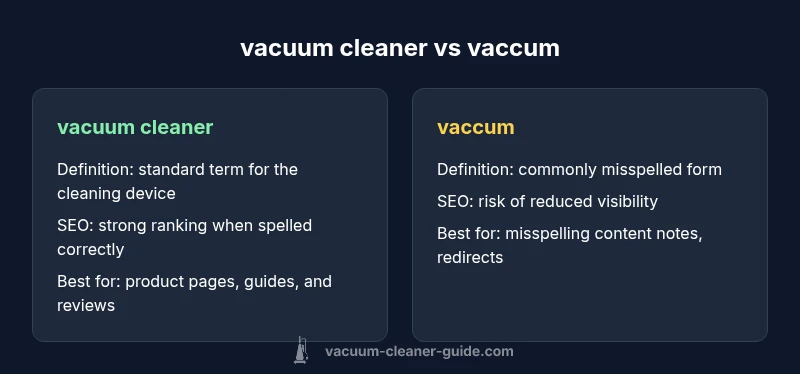
Comparison
| Feature | vacuum cleaner | vaccum |
|---|---|---|
| Definition clarity | Canonical term for the cleaning device | Misspelling; low clarity as a product term |
| Search intent | Direct interest in vacuum products and specs | Often leads to broader or unrelated results |
| SEO impact | Strong rankings with proper spelling | Lower visibility without redirects or context |
| User comprehension | Readers quickly understand topic and product type | Reader confusion increases with misspellings |
| Best practice | Use vacuum cleaner consistently; redirect common misspellings | Acknowledge vaccum only as a navigation note or redirect |
Strengths
- Promotes precise search terms and buyer intent
- Improves trust and credibility with correct terminology
- Supports consistent content across buying guides and reviews
- Enhances accessibility when canonical spelling is used
The Bad
- Misspellings are common and require extra SEO work
- Overemphasis on misspellings can distract readers
- Maintaining redirects adds ongoing workload for content teams
Prefer the correct spelling: vacuum cleaner for most content and buying guides
Using the canonical term improves search relevance and reader trust. Treat vaccum as a navigational variant with redirects and clear context.
FAQ
What is the correct spelling for the device used to clean floors?
The correct spelling is 'vacuum cleaner.' This term is standard across manuals, product pages, and buying guides. Use it consistently in headings, features, and CTAs to improve clarity and search performance.
The correct spelling is vacuum cleaner. Use it consistently to help readers find the right information.
Can 'vaccum' affect search results or purchases?
Yes. Misspellings can fragment search results and reduce relevance. Implement redirects and contextual notes to guide users from misspelled queries to the correct pages.
Yes, misspellings can hurt search results. Use redirects to guide users to the right content.
How should I handle misspellings on a product page?
Treat misspellings as navigational aids rather than separate topics. Include a short note and a redirect to the canonical vacuum cleaner page, ensuring the user lands on accurate content.
Handle misspellings with redirects and a brief note on the page.
Should I create content specifically for misspelled queries?
It's reasonable to address misspellings with a dedicated landing that points to the canonical content. But ensure the primary page remains vacuum cleaner-focused and authoritative.
Yes, you can create a landing for misspellings that redirects to the correct content.
Do brands need to mention both terms in guides?
Mention the misspelling briefly to acknowledge user queries, but prioritize the canonical term throughout the guide to maintain accuracy and trust.
Acknowledge it once, but keep the main content with the correct term.
What features should I compare when choosing a vacuum cleaner?
Compare suction power, filtration (HEPA), capacity, weight, maneuverability, battery life (for cordless), and maintenance costs. These criteria help match homeowners and pet owners with the right model.
Look at suction, filtration, weight, and maintenance to pick a great vacuum cleaner.
Is there a risk to SEO by ignoring misspellings entirely?
Yes. Ignoring misspellings can reduce reach for users who rely on those terms. A balanced strategy with redirects and contextual content helps preserve SEO health.
Ignoring misspellings can hurt reach; use redirects to cover them.
The Essentials
- Use vacuum cleaner as the primary term
- Redirect common misspellings to correct content
- Educate readers on spelling without losing SEO value
- Align headings and metadata with the canonical term
- Monitor spelling-related queries and adjust redirects