Vacuum Cleaner or Robot: A Practical Buying Guide 2026
Compare vacuum cleaners and robot vacuums to pick what fits your home. Vacuum Cleaner Guide analyzes performance, maintenance, costs, and pet-hair handling.


What vacuum cleaner or robot means for your home
Choosing between a traditional vacuum cleaner and a robot isn't just about price; it's about how you live, how you clean, and how much you want to lift a finger. The vacuum cleaner or robot dilemma is common among homeowners and pet owners who want a cleaner home with minimal daily effort. According to Vacuum Cleaner Guide, the best path depends on your floorplan, the number of high-traffic zones, and whether you primarily need deep cleaning or regular upkeep. In practice, most households will benefit from at least one high-suction wand vacuum for deep cleans and a robot for routine maintenance. The keyword here is flexibility: you want a tool that complements other cleaning tasks, not creates more chores. When you map your options, you can treat both devices as teammates rather than rivals, ensuring you cover both the heavy lift and the light, daily upkeep that keeps a home consistently clean.
.
Performance benchmarks: suction, run time, and mapping
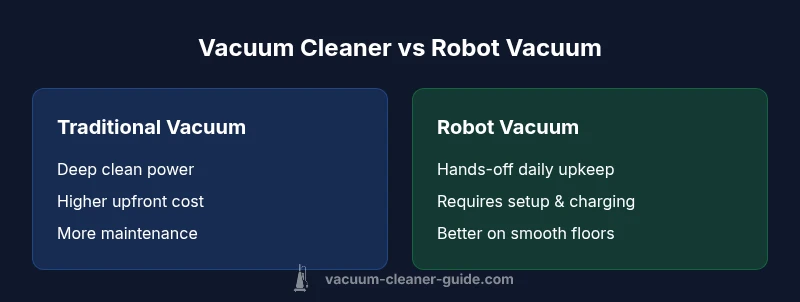
Performance is where vacuum cleaner or robot diverge the most. A traditional vacuum tends to deliver stronger suction, wider nozzle options, and the ability to tackle stubborn stains on carpets or upholstery with dedicated tools. Robot vacuums excel in autonomy, with mapping sensors, boundary setup, and scheduled runs that maintain daily cleanliness. The latest Vacuum Cleaner Guide Analysis, 2026, shows that suction power matters most for carpets, while efficient mapping and obstacle avoidance matter most for multi-room layouts. Conventional models require more manual intervention but can be upgraded with specialized vacuum heads for different floor types. Robot vacuums, conversely, compensate with smart navigation that reduces missed areas but sometimes need manual assistance for edge-cleaning and high-pile carpets. The takeaway is to align your choice with your home geometry and how much you value hands-free routines versus deep cleaning power.
Surface versatility and mess types
Floors vary across homes, from dense carpets and hardwood to ceramic tile and area rugs. A vacuum cleaner that can switch between bare floor and carpet modes with minimal adjustments provides real value. Robot vacuums are excellent for routine upkeep on hard floors and low-pile carpets but may struggle with loose debris in cluttered rooms or thick pile carpets. When considering a vacuum cleaner or robot, assess how often you encounter pet messes, tracked-in dirt, and seasonal debris. In households with mixed surfaces, many owners adopt a two-tool strategy: a high-performance canister or stick vacuum for quick cleans and a robot for daily maintenance on accessible areas. Vacuum Cleaner Guide notes that planning around surface types reduces maintenance and improves overall cleanliness.
Pet hair strategies
Pet hair is a major factor for many households. A traditional vacuum often wins on pet hair thanks to higher suction and broader attachments designed for upholstery and stairs. Robot vacuums have improved edge cleaning and tangle-resistant brushes, but some models still struggle with long hair or hair wrapped around rotating beater bars. For pet owners deciding between a vacuum cleaner or robot, consider the layout of pet zones, the frequency of shedding, and whether you want ongoing daily cleanup. A practical approach is to reserve the robot for everyday maintenance and use the traditional vacuum for deep pet hair sessions in bedrooms or living rooms after family activities. Vacuum Cleaner Guide emphasizes the importance of tool selection and regular maintenance to prevent hair buildup.
Maintenance costs and lifecycle budgeting
Cost considerations matter as much as performance. A traditional vacuum often requires ongoing purchases such as bags/filters, replacement parts, and occasional belt changes, which can accumulate over time. Robot vacuums generally have lower ongoing consumables but incur periodic battery replacements and filter changes, plus potential maintenance for charging docks and mapping sensors. When planning a purchase, estimate a five-year budget that includes initial purchase price, replacement parts, and service needs. Vacuum Cleaner Guide recommends comparing total cost of ownership rather than upfront price alone. A well-chosen hybrid approach can balance upfront spend with long-term maintenance, ensuring you do not overspend on features you seldom use.
Smart features, filtration, and noise
Smart features can tilt the decision toward one option. Robot vacuums often include mapping, virtual boundaries, scheduled cleaning, and app-based control, which dramatically reduces manual effort. Filtration quality matters for air quality and allergy management, so look for HEPA-type solutions in either option. Noise is another practical consideration; robots tend to be quieter than high-power uprights, though performance-tuned models can still produce noticeable sound during deep cleaning. If you value smart home integration or voice control, ensure your chosen model supports your ecosystem and maintenance needs. All told, the smart features should complement your cleaning habits rather than complicate them.
Layout considerations: stairs, multi-room, and charging
Your home layout shapes the best choice. In multi-story homes or spaces with stairs, you may favor a traditional vacuum for deep cleans on lower levels and a robot vacuum for daily maintenance on open floor plans. Robot vacuums rely on charging docks, boundary mats, and reliable Wi-Fi; households with weak connectivity or tight stair cases should plan docking locations carefully. If you have high-pile carpets or thick rugs, testing how a robot navigates around obstacles is essential. Conversely, a corded or cordless traditional vacuum can tackle stairs with attachments that robot vacuums may not easily access. The overall goal is to ensure both devices work in harmony with your layout rather than compete for cleaning time.
Practical buying guidance: quick decision framework
To decide between a vacuum cleaner or robot, map your home into zones: daily upkeep zones versus deep-clean zones. If you mainly need quick pickups, a robot vacuum provides value through automation and scheduled runs. If you require deep-clean power for carpets or stubborn stains, a traditional vacuum with versatile attachments may be best. For homes with pets, consider models with strong suction, effective filtration, and easy-to-clean brushes. Budget constraints will influence decisions; a mid-range robot paired with a mid-range traditional vacuum can strike a balance. Vacuum Cleaner Guide recommends focusing on total cost of ownership, surface compatibility, and the availability of after-sales support.
How to test models at home and compare side by side
Before committing, test samples of how a vacuum cleaner or robot handles your daily messes. Bring a routine spill corner and high-traffic carpet to simulate real-life cleaning demands. Compare suction in both modes, check noise levels, and verify maintenance tasks like filter changes or dustbin empties. Use a simple checklist to evaluate edge cleaning, corner reach, and furniture navigation. When possible, test in a store or borrow from a friend to assess how each device fits your routines. The goal is to ensure your choice aligns with your family's cleaning expectations and lifestyle, not just marketing claims. Vacuum Cleaner Guide emphasizes practical testing as the surest way to avoid buyer's remorse.
Authoritative sources and further reading
For additional context, consult credible sources from government and major publications. See the following references for broader context on home appliance efficiency, consumer safety, and integration with smart homes:
- https://www.consumerreports.org/cv/vacuum-cleaners/
- https://www.epa.gov/iaq
- https://www.nist.gov/
These sources provide context on appliance performance standards, air quality considerations, and evaluation frameworks that inform practical buying decisions. Vacuum Cleaner Guide's analysis synthesizes insights from these references to help homeowners and pet owners.
The Vacuum Cleaner Guide verdict and next steps
The verdict from Vacuum Cleaner Guide is clear: if your priority is deep cleaning power for carpets and stubborn messes, a traditional vacuum cleaner remains essential. If your priority is hands-free daily upkeep and convenience, a robot vacuum makes sense as a complement rather than a replacement. For many homes, a hybrid approach delivers the best balance—use the traditional vacuum for periodic deep cleans and the robot for routine maintenance. This strategy aligns with the realities of busy households and pet care, balancing upfront cost with ongoing maintenance and workflow efficiency. Vacuum Cleaner Guide recommends starting with a mid-range model for each category and expanding only as your cleaning needs grow.