Best vacuum cleaner for carpet and hardwood: 2026 Buying Guide
Comprehensive buying guide comparing multisurface vacuums ideal for carpet and hardwood, with a detailed feature table, maintenance tips, and expert verdict.


For carpet and hardwood, the best vacuum combines deep carpet cleaning with gentle hardwood care. Look for a multi-surface model with an adjustable brush roll, strong suction, and sealed filtration. Upright, canister, and select cordless sticks fit this niche, while dedicated hard-floor or pet-focused vacuums may fail on one surface.
Why a single vacuum matters for carpet and hardwood
In homes with both carpets and hardwood floors, a single, well-chosen vacuum reduces clutter, simplifies cleaning routines, and helps maintain consistent results. A multisurface vacuum should clean deeply into carpet fibers without dragging debris across delicate hardwood finishes. It should also avoid leaving a visible residue, buffing marks, or scratches, which is a particular concern on glossy or engineered floors. When evaluating machines, homeowners should consider the range of surfaces they encounter, the common debris types (pet hair, fine dust, crumbs), and the typical cleaning cadence. The Vacuum Cleaner Guide team notes that the best cross-surface models combine aggressive agitation for carpets with a soft touch on hardwood, plus a filtration system that captures allergens without compromising airflow. In practical terms, look for a unit with a floor-type switch or automatic brush-height adjustment, a brush roll designed for multiple materials, and sturdy wheels that won’t mar floor surfaces. By focusing on these capabilities, you’ll reduce the need to switch devices between rooms, save time, and improve overall upkeep of your floor plan.
Key design features for multi-surface cleaning
The core challenge of multisurface vacuums is to satisfy two seemingly conflicting goals: deep carpet cleaning and gentle hardwood maintenance. An adjustable brush roll is essential; it lets the machine engage carpet fibers for lift while retracting on hard floors to prevent scattering debris. A floor-type switch or sensor that reduces agitation automatically helps minimize scuffing. Suction performance matters, but airflow efficiency matters more: sealed, well-sealed filtration systems (HEPA-grade when possible) capture fine particles and pet dander without clogging. Noise level, tool assortment, and hose reach influence real-world usefulness. Pay attention to included attachments: a stiff-bristle brush for stubborn hair, a crevice tool for tight corners, and a soft brush for bare wood edges. Weight and balance affect ease of use on stairs and in tight spaces. Finally, check for compatibility with sealed hardwood finishes; some models explicitly advertise safe contact with sealed surfaces, which reduces risk of scratches. The best models offer clear indicators for brush mode, airflow, and maintenance reminders, enabling homeowners to optimize performance across diverse rooms.
Surface-specific challenges and how to mitigate
Carpet scuff resistance matters, especially on high-traffic areas. Heavy pet hair can clog brushes quickly; choose models with tangle-free brush designs or self-cleaning mechanisms. Hardwood floors require gentle cleaning to avoid scratching; look for soft wheels, smooth floor nozzles, and a wood-safe mode. Debris type varies by room: kitchen crumbs vs living room dust; a long hose and on-board tool storage helps. Some vacuums perform well on one surface but underperform on the other; for example, a powerful motor with a rigid sole plate may scatter debris on hardwood if not adjusted. The Vacuum Cleaner Guide approach recommends testing a model on a small area of each surface before committing, and keeping the brush height consistent as you move from carpet to hard floors. Routine maintenance reduces performance drift: clean the brush roller, check filters, and replace bags or cyclones as needed. If you own a pet, prioritize models with sealed filtration and a true HEPA option to minimize dander and odors. These practices keep floors looking clean and help you avoid damage over time.
Power source and runtime considerations
Corded vacuums offer steady power, which is valuable for large cleaning jobs and thick carpet piles. Cordless multi-surface vacuums provide convenience for quick touch-ups and stairs, but runtime and battery degradation over time can influence effectiveness. When evaluating cordless options, consider charge time, replacement batteries, and the ability to maintain suction as the battery drains. A common approach is to use a main corded unit for daily cleaning and reserve a lightweight cordless model for quick pickups and high-traffic areas. Some models include adapters that allow use with a small external battery pack or upgrades through tool kits, extending runtime without sacrificing performance. Weight distribution also matters: a well-balanced unit reduces fatigue during long cleaning sessions and easy control on slippery hardwood. Evaluate warranties and service networks; a model with reliable components often requires fewer repairs, ultimately reducing long-term costs. Inserting a well-planned mix of power options into your cleaning routine can yield consistent results across surfaces with less compromise.
Maintenance, filters, and long-term durability
Filter maintenance is crucial to preserve suction and air quality. Choose vacuums with sealed filtration and accessible, washable filters. Brush heads should be regularly checked for hair and thread tangles; belts should be replaced as recommended by the manufacturer. For hardwood cleaning, ensure wheels and nozzles are free of grit that could cause scratches; periodic checks for wheel wear and gasket integrity extend life. Bagless designs simplify debris disposal, but emptying containers properly reduces dust exposure. If you deal with pet hair or dust, you’ll appreciate a model with robust access to filters and a straightforward dust cup emptying mechanism. Look for a durable chassis and high-quality plastics that resist cracks when hoisted up stairs or pushed across rough thresholds. The Vacuum Cleaner Guide team emphasizes aligning maintenance with your home’s cleaning frequency; a little routine upkeep goes a long way toward maintaining multi-surface performance over years.
How to evaluate models: a practical criteria checklist
- Surface performance: test on carpet and hardwood; ensure the unit changes brush height effectively; verify that debris pickup is consistent across surfaces.
- Filtration: sealed systems with HEPA are preferable for allergen control; check replacement filter availability and cost.
- Maneuverability: weight, wheel design, foot pedal controls, and tool accessibility.
- Maintenance: availability of service centers, replacement parts, and ease of cleaning.
- Battery life (if cordless): runtime and memory of full-power suction as battery ages.
- Noise and durability: consider manufacturer warranties and consumer reviews.
- Price/value: weigh upfront cost against long-term savings from maintenance and energy efficiency.
Real-world scenarios: apartments, single-family homes, and stairs
In apartments with limited storage, light-weight cordless models that still offer adequate suction can handle routine cleaning on both carpet and hard floors. In single-family homes with mixed surfaces, a robust powered unit with good hose reach and attachments reduces the need to switch tools. For homes with stairs, weight and balance matter; a long hose and a comfortable grip will help. Ensure the model includes edge-cleaning features for baseboards and corners. The value of a multi-surface vacuum grows with pet ownership; sealed filtration and stronger brushes help manage hair and dander. These scenarios illustrate that the ideal model often depends on floor plan, traffic, and cleaning frequency. Vacuum Cleaner Guide's practical recommendations aim to equip you with a single, versatile device that minimizes compromise and fits your lifestyle.
Feature Comparison
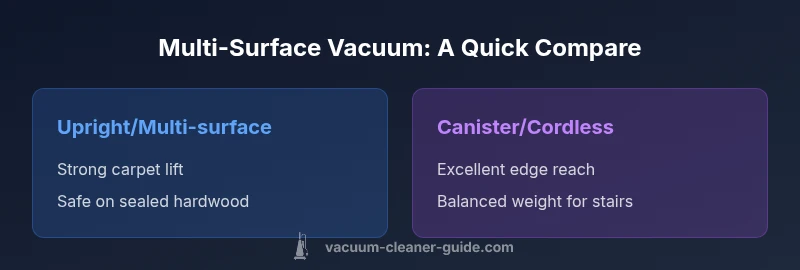
| Feature | Upright with dual-mode (multi-surface) | Canister/Cordless multi-surface | Stick vacuum with multi-surface capability | Robot vacuum with multi-surface programming |
|---|---|---|---|---|
| Brush height adjustability | Manual/auto adjust for carpets vs hardwood | Automatic or manual height control | Limited or fixed height | Smart mapping with surface-aware cleaning |
| Floor compatibility | Carpet (all piles) + sealed hardwood | Carpet + hardwood with dedicated hard-floor setting | Carpet-focused with occasional hard-floor mode | Hardwood-focused with occasional carpet mode |
| Filtration | Sealed filtration (HEPA option) | Sealed filtration with HEPA availability | Basic filtration | HEPA-grade options common |
| Run-time/Power | Consistent corded power | Cordless runtime varies by battery | Cordless with moderate runtime | Smart power management across surfaces |
| Best for | Deep carpet cleaning + hardwood safety | Versatility and mobility across rooms | Lightweight daily quick cleans | Smart navigation and automation for homes |
| Price range | Mid-to-high | Mid-to-high | Mid-range to high | Mid-to-high |
Strengths
- One vacuum handles both surfaces, reducing clutter
- Potential long-term savings vs buying separate units
- Improved allergen control with sealed filtration
- Good balance of power and versatility for homes with pets
The Bad
- May be less specialized than dedicated surface-specific models
- Cordless options can have limited runtime and peak power drop
- Maintenance can be more involved for brush system and filters
Versatile multisurface vacuums offer the strongest overall value for homes with carpet and hardwood.
Prioritize models with an adjustable brush, sealed filtration, and balanced weight. For best results, choose a unit that stays effective across both surface types without frequent tool changes.
FAQ
What is the best type of vacuum for carpet and hardwood?
The best option is a multisurface vacuum that can deep-clean carpets and clean hardwood safely. Look for adjustable brushes, sealed filtration, and a design that minimizes scuffing on wood.
A multisurface vacuum with an adjustable brush and sealed filtration is ideal for both carpet and hardwood floors.
Are cordless vacuums suitable for hardwood floors?
Cordless vacuums are convenient for quick cleans and stairs but may sacrifice run-time and peak suction. If you choose one, ensure it has strong maintenance-free wheels and a dedicated hard-floor mode.
Cordless can work, just check runtime and hard-floor performance.
Do I need a vacuum with a brush roll that switches on/off?
A switchable brush roll is highly beneficial for switching between carpets and hard floors. It helps prevent scattering debris on wood and improves carpet lift when needed.
Yes—switchable brush rolls make cross-surface cleaning easier.
How important is filtration for allergy sufferers?
Filtration is crucial for allergy management. A sealed system with HEPA or equivalent filtration traps allergens, reducing indoor air pollution and improving overall cleanliness.
Filtration matters a lot for allergens; choose sealed systems with HEPA when possible.
Can robot vacuums handle both carpet and hardwood?
Some robot vacuums perform well on smooth hardwood and low-pile carpet, but most require surface-specific settings or manual assistance for high-pile carpet. They are best as a supplement to a main multisurface model.
Robots can help, but they’re usually supplementary to a multisurface main unit.
The Essentials
- Choose a multisurface vacuum with an adjustable brush roll.
- Prioritize sealed filtration for allergy management.
- Corded power provides consistent suction for large jobs.
- Weight, balance, and maneuverability matter on stairs.
- Regular maintenance extends lifespan and performance.