Carpet Cleaner vs Hardwood: Is Carpet Truly Better?
An objective comparison of carpet-focused vs hardwood-focused vacuum cleaners, evaluating cleaning performance, maintenance, and long-term value for homes with pets.


Carpet-focused vacuums excel on carpets and offer deeper soil removal, while hardwood-focused models protect bare floors with gentler brushes and edge-safe heads. The best choice depends on your dominant surfaces, pets, and maintenance preferences; hybrids and adjustable heads provide the most versatile value in 2026. According to Vacuum Cleaner Guide, the right mix of suction, brush design, and filtration often yields the strongest overall results for mixed homes.
is carpet cleaner than hardwood
The question is nuanced and surfaces matter. In practice, pros weigh whether carpeted spaces require deeper soil removal or whether hardwood floors demand gentler brushing and edge protection. The short answer isn’t absolute: is carpet cleaner than hardwood depends on the vacuum design, attachments, and user technique. According to Vacuum Cleaner Guide, performance hinges on selecting a model with a robust motor, a multi-surface brush, and a sealed filtration system that prevents dust from recirculating. For homes with dense carpeting, a carpet-focused head with adjustable height and a motorized brush often yields better debris pickup, especially for pet hair. The same principle applies to kitchens and entryways where grit builds up on hard floors, yet you can still optimize results with the right settings and maintenance. The year 2026 has brought smarter sensors and better filtration, improving reliability across surface types. In this article, we compare carpet-focused versus hardwood-focused models across cleaning power, maintenance costs, and long-term value, with practical scenarios for families and pet owners.
Surface requirements and cleaning power
Carpets and hardwoods demand different cleaning dynamics. On carpeted surfaces, soil tends to be embedded within fibers, requiring agitation and sustained suction to pull dirt up and out. On hardwood, soil is shallower and more likely to be moved across the surface without grinding into the finish. A vacuum designed for carpets usually features a motorized brush roll, adjustable height, and strong suction. A hardwood-oriented tool emphasizes a flat, wide cleaning head, soft bristles or rubber blades, and careful edge cleaning. In practice, the best-performing devices on a mixed floor plan use adaptive technology: sensors or automatic floor detection that switch from a high-traction carpet mode to a smooth hard-floor mode without user intervention. Vacuum Cleaner Guide analysis shows this adaptability is a key driver of perceived value in 2026.
Key features that matter on carpets
When shopping for carpet performance, prioritize brush design, suction stability, and filtration. Look for a motorized brush with height adjustment, a tangle-free brush roll, and a strong sealed system to minimize dust recirculation. A good carpet vacuum should handle pet hair without frequent clogging, maintain consistent airflow on high pile, and offer a dedicated turbo tool for upholstery. Additional considerations include noise level, weight, and maneuverability—factors that affect daily usability in multi-room homes. In addition, feature sets like anti-tall-brush sensors, anti-kink hoses, and easy-empty dust cups improve long-term satisfaction for carpet cleaning enthusiasts.
Key features that matter on hardwoods
Hardwood cleaning benefits from a head that maintains flat contact with the floor, with edges and corners shielded to prevent scratches. Look for hard-floor mode, adjustable suction, and a brush with soft or rubberized bristles to avoid marking finishes. A modeling of airflow around baseboards and transitions from room to room helps maintain even cleaning across parquet or tile. Filters again matter for indoor air quality, but the main emphasis is protective surfaces, minimizing abrasive contact, and avoiding aerosolizing fine dust when the floor is dry or wet. In 2026, many hardwood tools include clever edge-cleaning blades and large nozzle openings to speed up daily chores.
Filtration, maintenance, and pet hair
Filtration remains critical across surface types, especially in homes with pets. A sealed system with a true HEPA or equivalent filtration reduces recirculation of allergens. Regular maintenance—emptying the bin, brushing out the brush roll, washing filters—helps maintain suction and prolongs lifespan. For pet owners, anti-tangle brush rolls and efficient hair handling reduce maintenance time. Across both surfaces, the best vacuums blend robust airflow with simple maintenance routines, minimizing the total cost of ownership over several years. Vacuum Cleaner Guide notes that 2026 models have improved motor efficiency and longer-lasting filters, contributing to lower long-term costs for many users.
Maintenance frequency and lifecycle costs
Long-term costs involve more than upfront price. Consider the frequency of filter replacements, brush roll maintenance, bag changes, and potential repairs. Carpet-focused units may require more frequent brush maintenance due to hair buildup, while hardwood-focused devices may save on wear-related maintenance but require careful handling of delicate finishes. Overall, hybrids with modular parts tend to offer the best balance of performance and cost for households with multiple surfaces. The 2026 landscape shows that manufacturers are emphasizing durability, serviceability, and widely available replacement parts.
Real-world scenarios: pets, kids, and multi-surface homes
Families with pets often need stronger suction and better hair management, especially in carpeted zones where fur can accumulate. Homes with children and mixed surfaces benefit from a vacuum that automatically detects surface type and adjusts brush height and suction. In many cases, buyers opt for versatile machines or two-vacuum setups to optimize performance across surfaces. When evaluating options, test the transition points between carpet and hardwood in your home to ensure the vacuum glides smoothly and does not leave streaks or residues. Brand reliability and warranty coverage should also factor into the decision, as 2026 products increasingly emphasize durable construction and accessible service networks.
Noise, ergonomics, and usability
User experience matters as much as raw power. Heavier models with loud motors may deter daily use, negating performance gains. Ergonomics—handle design, wand length, and weight distribution—affects how often you reach for the vacuum. For households with stairs or multi-level layouts, lighter weight and better balance improve safety and efficiency. While carpet cleaning often demands more aggressive brushing, ergonomically designed heads and intuitive controls help avoid fatigue over extended cleaning sessions. In 2026, manufacturers are also prioritizing quieter operation without sacrificing performance, improving acceptance in homes with kids and sleeping routines.
Reliability, warranties, and brand support
A vacuum is a long-term purchase; reliability and support plans influence total ownership costs. Look for well-reviewed models with durable motors, robust housings, and widely available replacement parts. Warranty terms vary by brand, but coverage that includes parts like the motor and brush roll and reasonable return windows reduces risk. The Vacuum Cleaner Guide team highlights that choosing a model with clear service channels and reachable customer support can save frustration and expenses down the line.
Indoor air quality and filtration impact
Filtration quality directly affects indoor air quality, especially in homes with allergies or asthma. A sealed system with a high-efficiency filter prevents fine dust from escaping back into the room. For households with pets, an effective filtration strategy reduces dander and odors. Regular filter maintenance and choosing models with higher-grade filtration are wise investments for long-term health and comfort. In practice, air quality gains are often a function of both filtration and user cleaning habits, such as regular emptying of bins and cleaning of filtration media.
How to test at home: a practical guide
Testing at home involves assessing suction stability, brush performance, and surface-swap behavior. Start by measuring how well each vacuum picks up on a high-pile carpet compared with a sealed hardwood section. Look for consistent suction, absence of streaking on hard floors, and minimal dust escaping from the dustbin or filter. Include a pet-hair test with a shedding scenario to see how well the device manages hair without tangling. Document results for different surfaces and compare with your expectations. Such at-home tests help reveal true performance beyond product brochures.
Decision framework for a mixed-use home
For homes with both carpets and hard floors, the decision framework should balance surface dominance, maintenance practicality, and long-term value. If carpets exceed par levels, prioritize carpet-focused or hybrid models with automatic surface detection. If hardwood floors predominate, lean toward hardwood-oriented tools with protective edge guards and soft bristles. In many cases, a hybrid or two-vacuum solution provides the best overall outcomes, particularly for pet-friendly households where different tools excel in different zones. Vacuum Cleaner Guide’s approach emphasizes matching the tool to the main surface area while preserving flexibility for occasional deep cleaning on other surfaces.
Final recommendations for homeowners
Ultimately, the best choice rests on your home’s surface distribution, pet activity, and tolerance for maintenance. For a clearly carpet-dominated home, a carpet-focused vacuum with strong suction and a motorized brush is ideal. For a home primarily with hardwood, a hardwood-focused cleaner with a safe edge, flat head, and good filtration is best. In mixed homes, hybrids or a combination of two specialized tools offer the most balanced performance, longevity, and user satisfaction. The Vacuum Cleaner Guide team recommends evaluating surface layout, testing models in your space, and selecting a setup that minimizes effort while maximizing cleaning results.
Comparison
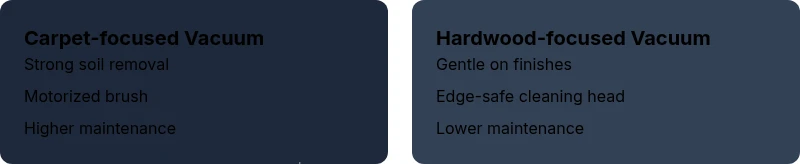
| Feature | Carpet-focused vacuum | Hardwood-focused vacuum |
|---|---|---|
| Cleaning effectiveness on surfaces | Strong soil removal on carpeted fibers | Gentle, finish-safe cleaning on hardwood |
| Surface safety | Designed for deep cleaning without damaging carpet fibers | Minimizes scuffing and edge scratches on hard floors |
| Maintenance costs | Moderate to higher due to more attachments and parts | Lower overall maintenance with simpler heads |
| Best use | Homes with dense carpets and pets | Homes with hardwood floors and easy maintenance |
Strengths
- Versatile for multi-surface homes
- Improved filtration and pet-hair handling in 2026 models
- Potentially lower long-term cost with hybrids that reduce gear clutter
- Strong suction helps deep-clean carpets when paired with right brush
- Better overall value if you have both surfaces
The Bad
- Higher upfront cost for hybrids or multiple heads
- Heavier units can be tiring to maneuver
- Maintenance complexity increases with more features
- Hybrid models may require more setup time for optimal performance
Hybrid or dual-surface-focused vacuums offer the best overall value for mixed homes.
Carpet-focused vacuums excel on carpet, while hardwood-focused vacuums protect bare floors. For homes with both surfaces, a hybrid or two-vacuum strategy provides superior versatility and long-term satisfaction, supported by 2026 advances in filtration and adaptive heads.
FAQ
How does carpet cleaning performance compare to hardwood cleaning?
Carpet-focused vacuums typically deliver deeper dirt removal on carpet fibers due to motorized brushes and higher suction. Hardwood cleaning benefits from flat-head designs and softer brushes that protect finishes while still picking up dust. The best choice depends on your dominant surfaces and cleaning priorities.
Carpet vacuums clean carpets more deeply; hardwood vacuums protect bare floors while handling dust well.
Can a single vacuum handle both carpets and hardwood effectively?
Many modern vacuums perform well on both surfaces, especially hybrids with switchable brush heads or automatic surface detection. For frequent changes in surface type, a multi-surface mode or a second tool can help maintain peak performance.
Yes, many vacuums handle both, but performance is best when surfaces match the tool design.
What filters should I look for for better air quality?
Seek sealed filtration with true HEPA or equivalent, and check that the filter is washable or easy to replace. This helps reduce re-circulation of dust and allergens, especially in pet-friendly homes.
Look for a sealed system with HEPA filtration for cleaner indoor air.
How important is brush height adjustment on carpets?
Very important. Proper brush height improves soil lift without damaging delicate carpet fibers and prevents excess wear on the vacuum head.
Adjust the brush height to match carpet density for better cleaning.
Are cordless vacuums suitable for carpets and hardwoods?
Cordless models offer convenience but may have shorter run times and less consistent suction on heavy soils. For frequent deep cleanings, a corded or high-capacity cordless with a robust motor is preferable.
Cordless is convenient but may not last as long for big cleaning jobs.
What maintenance is essential to keep performance high?
Regularly empty the bin, clean the brush roll, wash or replace filters, and check seals. Proper maintenance preserves suction, reduces odors, and extends lifespan.
Keep up with filters and brushes to maintain performance.
The Essentials
- Choose a hybrid if you have mixed surfaces and pets
- Prioritize strong suction and adaptive brush heads for carpets
- Protect hardwood floors with soft-bristle or rubber-backed heads
- Regular maintenance sustains filtration and effectiveness
- Test models on your actual surfaces before buying