How Much Vacuum Cleaner Costs in 2026: A Price Guide
Explore how much vacuum cleaners cost in 2026, with price bands by model type, ownership costs, and buying tips for pet owners and households with mixed flooring.


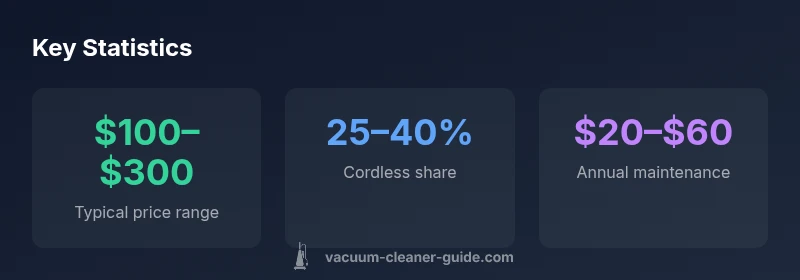
Typical household vacuum cleaners cost between $100 and $300 for standard models, with canister and cordless units often reaching $400–$800 depending on features. Budget options under $100 exist but offer limited suction and durability. For pet owners or allergy sufferers, investing in higher-end models with HEPA filters and durable brushes can pay off in cleaning performance.
Understanding Pricing Drivers for Vacuum Cleaners
Prices across vacuum cleaners vary widely because they reflect several fundamental price drivers: model type, motor power and suction, filtration quality, build materials, warranty, and the included accessories. How much vacuum cleaner costs is not a single number; it’s a ladder of choices that balance performance with budget. According to Vacuum Cleaner Guide analysis, entry-level broom-style or compact uprights can be surprisingly affordable, while premium cordless, canister, and robot vacuums push into higher price bands. When you translate sticker price into real value, consider not just suction strength but also reliability, filter longevity, and ease of maintenance. Homeowners should also factor energy consumption and noise, which can add to long-term costs. In 2026, the landscape has grown more diverse: more competitors offer multi-surface capabilities, better filtration, and smarter maintenance reminders. This section unpacks price drivers and shows where the most meaningful trade-offs lie for typical households, from pet-friendly homes to spaces with mixed flooring.
Price bands by model type and what you get at each level
Price tiers map to how you intend to use the vacuum. Entry-level models (under $150) are often compact or bagless, providing basic cleaning for everyday tasks. Mid-range options ($150–$350) add stronger suction, better filtration, and more attachments. Premium upright, canister, or cordless models ($350–$800+) deliver advanced brush systems, HEPA filtration, longer warranties, and smart features like app connectivity or self-cleaning brushes. For homes with pets or heavy traffic, a higher price often translates into more durable motors and longer-lasting filters. Before you buy, compare the features that genuinely impact your space, and beware that the sticker price may not reflect ongoing costs such as bag replacements or filter changes.
When higher price pays off: pet care and allergy considerations
If you share your home with pets or allergy sufferers, higher-priced models with sealed filtration and robust pet-hair tools can reduce dander and hair remnant on carpets and furniture. HEPA or sealed filtration minimizes allergen leakage, while upgraded motors and brush heads handle fur without clogging. The trade-off is paying for maintenance-friendly components and longer-lasting parts. Vacuum Cleaner Guide analysis suggests that mid-to-high-end models frequently outperform bargain units in real-world cleaning time and energy efficiency, especially in homes with multiple floor types.
Total ownership cost: beyond the upfront price
Upfront price is only part of the cost equation. Energy usage, filter replacements, bags, and occasional repairs can add meaningfully to the lifetime cost of ownership. Corded vacuums typically consume more electricity during use but require less frequent battery maintenance, while cordless models deliver convenience at the cost of faster battery replacement cycles. A practical rule is to estimate annual maintenance at $20–$60 and account for replacement filters every 6–12 months depending on usage. Over a five-year horizon, the cumulative maintenance can rival or exceed the initial price for some models.
How to compare price vs performance during shopping
Create a checklist that aligns your needs with a model’s features: suction power (measured in air watts), filtration (HEPA vs non-HEPA), weight, and noise level. Read independent reviews and verify warranty terms. Consider the cost of consumables like bags and filters and how often they will need replacement. A well-chosen mid-range model can outperform a pricier one if it better fits your home’s floor plan and cleaning habits, reducing the time spent cleaning and extending the life of your floors.
Budget-friendly purchasing plan for common homes
- For apartments or small homes: look for compact or handheld models under $150 with good filtration. - For families with pets or children: aim for $200–$400 with strong suction and durable brushes. - For large multi-floor homes: consider a corded model in the $300–$500 range and keep a lightweight cordless for quick touch-ups. - For tech enthusiasts: a premium cordless or robot in the $500–$800 range can offer convenience plus smart features, but ensure long-term maintenance costs are included.
Common price myths and how to avoid overpay
Myth: More expensive always means better cleaning. Reality: Fit and maintenance matter more than sticker price. Myth: Filters are optional. Reality: Replacing filters preserves suction and protects your air quality. Myth: Sales always save money. Reality: Timing, bundles, and coupons matter; compare total cost over five years.
Price ranges by model type
| Model Type | Typical Price Range | Key Features |
|---|---|---|
| Upright | $80–$300 | All-around performance; easy to store |
| Canister | $150–$350 | Versatile cleaning; strong suction |
| Cordless | $250–$800 | Portable; quick pickups; rechargeable battery |
| Robot | $400–$1200 | Automation; mapping; requires charging station |
| Handheld | $60–$150 | Spot cleaning; lighter tasks |
FAQ
What is the average price of a good vacuum cleaner in 2026?
Prices vary by model type. Entry-level vacuums commonly range from around $100 to $150, mid-range models from $180 to $350, and premium options from $500 to $700+, with cordless and robot vacuums generally at the higher end. Pet-friendly models with HEPA filtration often sit in the upper-middle range.
Prices vary by model type; entry-level vacuums start around a hundred dollars, while premium units can reach seven hundred or more. Look for HEPA filters if you have pets.
Do I need HEPA filtration in a vacuum?
HEPA filtration helps capture fine particles and is especially useful for allergy sufferers or households with pets. If you value air quality and long-term cleanliness, prioritize HEPA-equipped models, but check filtration replacement costs.
If allergies or pet dander are a concern, HEPA helps a lot. Just factor in replacement costs.
Are cordless vacuums worth it for large homes?
Cordless vacuums offer portability and quick pickups but may lack the running time of corded models. For large homes, consider a corded unit for main cleaning and use cordless for quick tasks.
They’re handy for quick cleanups, but for large homes you might still want a corded model for longer sessions.
How often should I replace filters and bags?
Most manufacturers recommend checking filters monthly and replacing HEPA or prefilters annually in typical use. Bagged uprights require bag changes when full; canister or bagless variants have different maintenance.
Check filters every month, replace as recommended; bags when full.
What should I know about price vs performance for pet hair?
Pet hair cleans best with strong suction, robust brushes, and effective filtration. Budget for a model with dedicated pet-hair features, but balance price against maintenance costs like brush wear.
For pets, prioritize power and filtration; plan for maintenance costs too.
“Price is a proxy for performance and durability; investing in a higher-quality vacuum often pays off in fewer repairs and better long-term energy efficiency.”
The Essentials
- Start with model type and features to estimate price
- Expect higher upfront costs for HEPA and durable parts
- Cordless models offer portability but may need battery consideration
- Total ownership cost includes maintenance and energy use
- Budget smartly by matching your use case to features