How Much Is Vacuum Cleaner In 2026? A Comprehensive Buyer's Guide
Explore realistic price bands for vacuum cleaners in 2026, with practical buying guidance, price drivers, and strategies to max value without overspending.


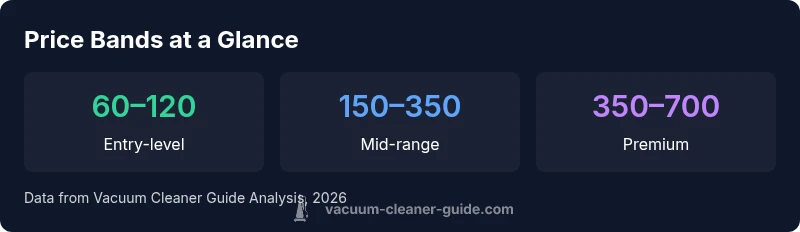
The question “how much is vacuum cleaner in” signals a price-focused search across entry-level, mid-range, and premium models. In 2026, price bands commonly show entry-level around $60–$120, mid-range $150–$350, and premium $350–$700, with differences driven by type, filtration, attachments, and warranty. Vacuum Cleaner Guide Analysis, 2026 confirms that brand and feature sets heavily influence sticker price, not just suction power.
The price landscape in 2026
In 2026, price awareness remains a top priority for homeowners and pet owners, often starting with a query like the phrase "how much is vacuum cleaner in". This not-quite-a-search highlights the need to understand price bands before narrowing down models. Vacuum Cleaner Guide Analysis, 2026 shows that price is driven by several levers: vacuum type (upright, canister, cordless, robotic), filtration level (HEPA vs. standard), motor power and suction, warranty length, and the breadth of attachments. Retail dynamics, including seasonal sales and bundle deals, further modulate the sticker price. Practically, you should separate upfront cost from long-term value: a cheaper model might incur higher maintenance or more frequent replacements. As a rule, entry-level units are lean on features but light on cost, while premium units deliver advanced filtration, stronger suction, and smart features. The key is to align price with your home realities—surface types, pet hair loads, stairs, and noise tolerance—so your purchase pays off over years rather than months.
Price bands by vacuum type
Different vacuum types cluster into distinct price bands, and understanding these bands helps homeowners budget with confidence. Uprights and canisters typically land in the mid-range for everyday homes, while cordless sticks offer convenience at a broad price spread, and robotic vacuums command premium pricing for mapping and autonomous cleaning. Entry-level uprights can be found in the lower band, mid-range models in the mid band, and premium robot vacuums or high-end canisters in the upper tier. Keep in mind that the same type can vary widely by brand and features, so always compare filtration, battery life (for cordless), and warranty terms when weighing cost against performance.
Brand and features that push price higher
Brand reputation, filtration quality, and feature sets are the primary price multipliers. Brands with long-standing consumer trust often command higher prices even for similar specs. Features like multi-stage filtration (HEPA), sealed systems to prevent dust leakage, self-emptying bins, enhanced LED headlights, advanced mapping, voice-control compatibility, and app-based diagnostics all push price upward. The most meaningful value, however, comes from a fit between your home needs and these features. If you have pets, prioritize strong filtration and easy maintenance; if you have hardwood floors, soft brushes and multi-surface capability matter more. The key is to avoid paying for bells and whistles you won’t use regularly.
Hidden costs and why prices vary
Sticker price is not the full story. Hidden costs include filter replacements, belt and brush wear, bag refills, battery replacements for cordless units, and optional extended warranties. For cordless vacuums, battery longevity and replacement costs can tilt the total ownership price significantly. Similarly, premium models may require proprietary filters that cost more over time. When evaluating price, add these recurring costs to the upfront sticker and consider the total cost of ownership over 3–5 years to compare value accurately. This broader view helps homeowners avoid sticker shock and choose models that stay affordable in the long run.
Strategies to pay less without compromising performance
Smart shoppers apply a few practical strategies to reduce cost while preserving essential performance. First, time the purchase with major sales events (holiday weekends, end-of-season clearances) to maximize discounts. Second, consider open-box or gently used units with full or partial warranties from reputable retailers. Third, compare bundles that include attachments and extra filters, which can increase perceived value and reduce per-item costs over time. Fourth, look for models with replaceable batteries or widely available replacement parts, ensuring ongoing affordability. Fifth, prioritize features that directly address your use case (pet hair, multi-surface cleaning, or quiet operation) rather than chasing the most expensive tech otherwise. By focusing on needs and timing, you can secure a price that aligns with real-world use.
How to read price labels and warranties
Finally, read the fine print on price labels and warranties. Look for the model number’s associated warranty length, what is covered, and whether parts like brushes, belts, and filters are included or sold separately. A longer warranty can reduce risk and cost of ownership, especially for busy households. Also pay attention to product reviews that reveal real-world reliability and maintenance costs. The goal is to identify a model that delivers the best balance of performance, durability, and predictable costs over time.
Quick-start buying checklist
Before you buy, run through this concise checklist: (1) define your primary surfaces (carpet, hardwood, tiles) and pet-related needs; (2) set a reasonable price band; (3) compare filtration, suction, and noise; (4) verify maintenance costs and replacement parts; (5) confirm warranty terms and service options. By ticking off these items, you’ll select a vacuum cleaner that meets your home’s demands without overpaying for features you won’t use.
Typical price bands by category
| Category | Typical Price Range (USD) | Key Benefits |
|---|---|---|
| Entry-level vacuum | 60–120 | Affordable option for light chores and small spaces |
| Mid-range vacuum | 150–350 | Balanced performance and better filtration |
| Premium vacuum | 350–700 | Strong filtration, advanced features, durable |
FAQ
What is the typical price range for entry-level vacuums?
Entry-level vacuums usually fall in the lower end of the spectrum, commonly around $60 to $120 depending on brand and feature set.
Entry-level vacuums usually cost between sixty and one hundred twenty dollars, depending on features.
Are premium brands always more expensive?
Premium brands often command higher prices due to build quality, filtration, and warranty coverage, but the best value depends on aligning features with your needs.
Premium brands tend to cost more, but value comes from features that match your needs.
Do cordless vacuums offer better value for money?
Cordless models offer convenience and portability, with price varying by battery life and suction. If weighed against ongoing battery costs and replacement parts, value depends on usage patterns.
Cordless vacuums are convenient, but assess battery life and ongoing costs to judge value.
Should I buy refurbished or open-box vacuums?
Refurbished options can provide solid savings when backed by a warranty and verified condition from reputable sellers. Always check return policies and parts availability.
Refurbished vacuums can save money if they come with a warranty and proper condition checks.
How often do prices drop during sales?
Prices typically drop during major sale events and holiday promotions. Planning ahead and tracking deals can yield substantial savings.
Prices often fall during big sale events; monitor deals to save.
“Price is a proxy for value, not a guarantee of performance. Focus on feature fit to your home rather than chasing the highest sticker price.”
The Essentials
- Identify your surface needs before shopping.
- Expect price bands by category to guide budgeting.
- Consider total cost of ownership, not just sticker price.
- Prioritize features that address your home’s realities.
- Watch for sales and bundles to maximize value.