How Much Are Vacuum Cleaners at Target? A Practical Buying Guide
Explore how Target prices vacuum cleaners, what drives cost, and how to pick the best model for homes with pets. Get practical buying guidance and promo timing insights from Vacuum Cleaner Guide.


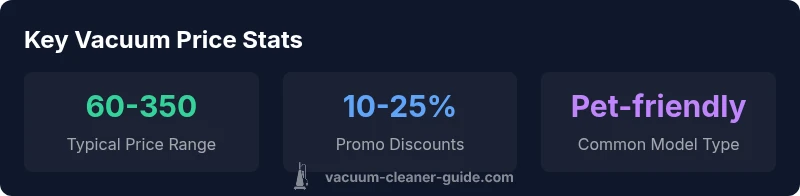
Prices for vacuum cleaners at Target span roughly $60 to $350, depending on model and features. Entry-level corded vacuums start near $60–$100, cordless handhelds around $80–$180, and full-size upright or canister models often in the $150–$350 range. Target promotions can trim prices further during sales events. Vacuum Cleaner Guide Analysis, 2026, notes that price variety mirrors feature sets and brand choices.
How Target prices vacuum cleaners: a quick map
For shoppers asking how much are vacuum cleaners at target, the answer hinges on model type, features, and promotions. Target carries a spectrum from compact, entry-level corded units to cordless handhelds and to full-size uprights designed for carpets and heavy-duty cleaning. In 2026, the price ladder mirrors consumer demand for portability, performance, and ease of maintenance. The lowest-priced options serve small spaces and light everyday tasks, while spending increases with newer battery technology, stronger suction, and better filtration. The price difference between basic and feature-rich models is often explained by battery life, motor wattage, and filter quality, which means a shopper can tailor a purchase to their budget without sacrificing essential performance. Vacuum Cleaner Guide Team notes that promotions and retailer discount events are a major driver of the actual out-the-door price, so timing can matter as much as the model you pick.
Price bands by model type
Target organizes price bands by model category: entry-level corded vacuums usually sit in the lower end of the spectrum; cordless handhelds often sit in the middle; full-size uprights and pet-focused models range higher, and canisters fall in between. Practical figures: entry-level corded generally around $60–$100, mid-range cordless often $100–$180, and upright/pet-focused models typically $150–$350. Promotions during sales events can shift these ranges modestly downward. Remember that a model with more attachments, better filtration (HEPA), and a longer warranty will compete in price with higher-cost options, even when the base price is similar.
Factors that influence price at Target
Model type is the primary driver of price. Corded basics are cheaper to manufacture and maintain, while cordless models add battery cost and advanced electronics. Filtration quality, such as HEPA or sealed systems, increases final pricing and long-term running costs. Attachments matter too: motorized brush heads, crevice tools, and floor-specific heads add to both price and utility. Brand reputation and warranty length influence sticker price, with well-known brands often commanding premium but offering perceived reliability. Promotions, stock levels, and retailer-specific bundles also affect the exact tag you see on the shelf.
Promotions and timing: when to shop Target vacuums
Target tends to run promotions around major shopping periods, including holiday seasons, back-to-school, and long-weekend sales. Online listings can differ from in-store displays during peak promo days, so cross-check both venues. If you see a model you want, set price alerts or add it to your cart when a deal pops up, because savings can vanish quickly. The best value often comes from pairing a model with a robust warranty and accessible replacement parts or filters.
How to compare models on Target's shelves
Start by clarifying your use-case: pet hair on stairs, hard floors, or carpet cleaning. Then compare at least three criteria: suction and airflow (or equivalent performance metrics), filtration quality, and attachments. Weight, cord length or battery life, and charging time are practical daily considerations. Check reviews for real-world performance and verify warranty terms. Finally, factor in ongoing costs such as filters and bags to estimate total ownership.
Budget-conscious shopper strategies
Leverage Target Circle member benefits and promo codes to maximize discounts. Compare online and in-store prices, as stock and promotions can diverge. Consider open-box or discontinued models if available, but confirm return policies. For pet owners, prioritize models with easy-to-clean parts and reliable filtration, and balance upfront cost with running costs over a few years.
Maintenance and total cost of ownership
Ongoing costs include filters, bags (if applicable), and energy use. HEPA filtration, washable filters, and self-cleaning brush heads can lower maintenance costs over time but may raise upfront price. Long-term ownership reliability matters; select models with accessible service centers and widely available replacement parts.
Practical examples: typical prices for common scenarios
For a small apartment with light cleaning needs, a basic corded model at the lower end is often sufficient, with total ownership costs staying near the entry range. A pet-friendly home frequently benefits from mid-range upright or canister options that balance suction, filtration, and attachments, landing in the mid-to-high range. A household with stairs and hard floors benefits from cordless or bagless uprights with versatile fittings, typically in the mid to upper price band depending on battery life and filtration.
Target vacuum price bands by model type
| Model Type | Typical Price Range | Key Pros | Notes |
|---|---|---|---|
| Entry-level corded | 60-100 | Lightweight, simple operation | Best for small spaces |
| Cordless handheld | 80-180 | Easy for quick cleanups | Limited runtime on full power |
| Full-size upright (pet-focused) | 150-350 | Strong suction, good for carpets | Ideal for homes with pets |
| Canister (compact) | 120-250 | Versatile with attachments | Good all-rounder |
| Robot vacuum (basic) | 100-250 | Hands-off daily maintenance | Supplement for pet homes |
FAQ
Are vacuum cleaners at Target cheaper than at specialty stores?
Prices at Target can be competitive, especially during promotions. However, certain premium models may be similar or cheaper at specialty stores depending on color, model year, and bundles. Always compare features and warranties across retailers.
Target often runs sales that can beat specialty stores, but compare features and warranties to be sure you're getting the best value.
What factors affect Target vacuum prices?
Model type, battery technology, filtration, attachments, and brand influence price. Cordless models usually cost more upfront due to batteries, while pet-focused or HEPA-filtered designs may push prices higher.
Price depends on model type, features, and promotions.
Does Target offer price matching or promotions on vacuums?
Target runs promotions and often provides price adjustments within policy. Check current codes and Circle membership for extra savings.
Yes—look for promos and Circle program deals.
Which Target vacuum is best for homes with pets?
Focus on models with strong suction, sealed filtration, and easy-to-clean attachments. Uprights and canisters designed for pet hair typically perform well.
For pet homes, prioritize suction, filtration, and easy maintenance.
Are robot vacuums at Target good for pet hair?
Robot vacuums are convenient for daily maintenance but may struggle with heavy pet hair. Use them as a supplement to a primary cleaner.
Great for daily upkeep, but may need extra passes for pet hair.
What else should I compare besides price?
Consider suction power, filtration, attachments, cord length or battery life, warranty, and replacement parts availability.
Look at power, filters, and warranties, not just price.
“Target's price range for vacuums reflects a healthy balance between value-focused basics and feature-rich options. Shoppers who compare specs and promotions consistently secure the best overall value.”
The Essentials
- Define your space and needs to pick a price tier
- Watch for promotions to maximize value
- Cordless offers convenience but check runtime and battery life
- Consider total cost beyond sticker price (filters, bags, energy)
- Compare features across brands